

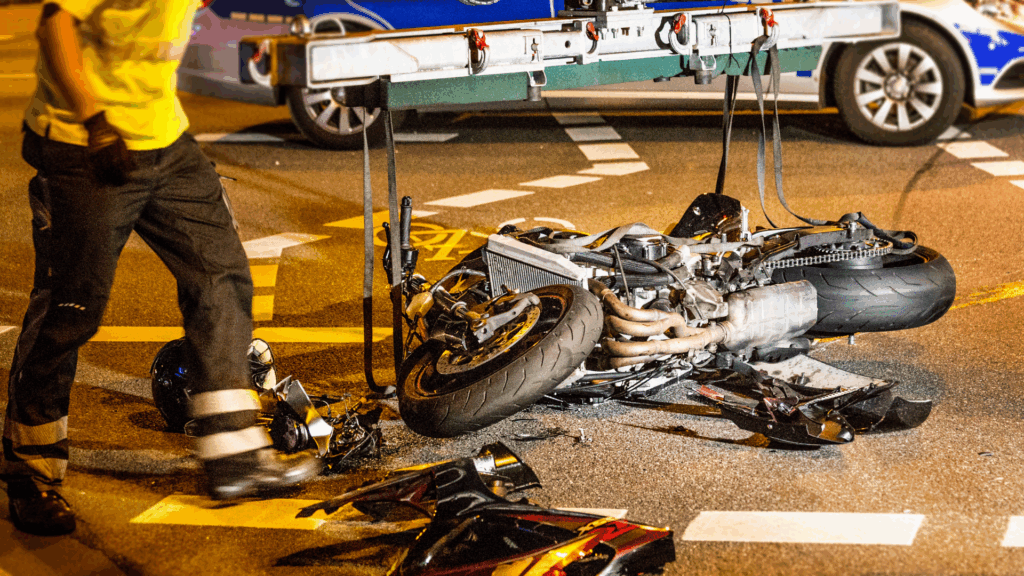
A Pacific Beach motorcycle crash on Friday, November 21, 2025, left a 35-year-old pedestrian with life-threatening injuries, according to FOX 5 San Diego. It happened shortly after 9 p.m. in the 1900 block of Garnet Avenue. Police said the man was walking south in the east crosswalk against a red “don’t walk” signal. A 21-year-old man riding a Suzuki motorcycle east on Garnet Avenue collided with him. The pedestrian suffered a lacerated liver, a broken femur and several other fractures, and paramedics took him to a hospital. The rider had multiple abrasions. Officers from the San Diego Police Department (SDPD) Traffic Division responded and said they did not believe alcohol or drugs played a role.
If a motorcycle hit you while you were walking in San Diego, or hit someone in your family, the questions come fast. Who pays the hospital? Does crossing against a signal end the claim? How long do you have to act? This post answers those questions under California law. It does not decide who was at fault on Garnet Avenue, because that is for the evidence to show.
The Law Office of Michelle Gershen is a personal injury practice in San Diego. Michelle Gershen has been licensed in California since 1994, and she handles every case herself. Before she represented injured people, she litigated for the defense side. That background gives her a clear view of how insurers size up a pedestrian claim.
If you or a family member was hurt in a crash like this one, call Gershen Law at (619) 492-5526 for a free consultation. Michelle’s intake team answers calls 24/7.
Can a Pedestrian Still Recover in California After Crossing Against the Signal?
Yes, a pedestrian can still recover in many cases. California follows pure comparative negligence, the rule the California Supreme Court adopted in Li v. Yellow Cab Co. (1975). A pedestrian found partly at fault can still collect damages, reduced by their own share of the fault. That rule applies to every San Diego pedestrian accident claim where an insurer points to the signal.
California has no cutoff at 50% or 51% fault. A pedestrian assigned 30% of the fault keeps 70% of the damages. One assigned 60% still keeps 40%. Those figures are illustrations, not predictions, because the split in a real case depends on the evidence.
How a Fault Percentage Changes a San Diego Pedestrian Injury Claim
Insurers use the same percentage math in settlement talks that a jury would use at trial. An adjuster who reads “against the signal” in a report may start with a high fault number for the pedestrian. Every point of that number comes off the recovery, so it is worth testing against the evidence. Evidence Code section 669 also plays a part. It lets a jury presume a person was careless when they broke a safety law and the violation caused an injury. That presumption can apply to a pedestrian who broke a signal law. It can also apply to a driver who broke a speed law. Either one can rebut it with proof that they acted with reasonable care.
Why the Police Account Is Not the Final Word on Fault
The details in the news came from what investigators said in the hours after the crash. A crash report records what officers saw and were told, but it is not a court ruling. In a civil claim, insurers weigh all the evidence. If a lawsuit is filed, a judge or jury decides each person’s share. Under Vehicle Code section 20012, a person named as injured in a crash report can get a copy from the agency that wrote it. For this crash, that agency is the SDPD.
Signal Timing Records and Video Along Garnet Avenue
Signal timing records can show exactly when each traffic light and walk signal changed. Those records usually sit with the city agency that runs the signal. Businesses along Garnet Avenue may also have cameras facing the street. Some systems keep footage only for a short time, so a written request sent early improves the chance of saving it.
Witnesses and Physical Evidence From the Scene
Police asked anyone who saw the crash to contact the SDPD Traffic Division or Crime Stoppers. An independent witness can speak to the signal, the lighting and where each person was just before impact. Damage to the motorcycle, the point of impact and the pattern of injuries can help an accident reconstruction expert estimate speed and sight lines. None of this assumes what the evidence will show in this case.
What Do California Crosswalk Laws Say About Pedestrians and Motorcycle Riders?
Vehicle Code section 21950 sets the basic crosswalk rules. They apply to motorcycle riders, because section 400 defines a motorcycle as a motor vehicle. A driver must yield to a pedestrian in a marked crosswalk, or an unmarked one at an intersection, unless the code provides otherwise. Traffic signals are the main exception. Under section 21451, a driver with a green light must yield to pedestrians lawfully within the crosswalk.
Section 21950 puts duties on both people. A pedestrian must use due care for their own safety. A pedestrian also may not suddenly step into the path of a vehicle close enough to be an immediate hazard. A driver approaching a pedestrian in a crosswalk must use all due care and slow down or take other action to protect that person. Subdivision (d) adds that the pedestrian’s duty does not excuse the driver from that care.
What Don’t Walk and Countdown Signals Mean Under California Law
Vehicle Code section 21453 says a pedestrian facing a steady red light may not enter the roadway unless a pedestrian signal directs otherwise. Section 21456 covers the walk and don’t walk signals themselves. A flashing upraised hand with a countdown lets a pedestrian start crossing, but the crossing must be finished before the countdown ends. A steady don’t walk signal, or a flashing one with no countdown, means a pedestrian may not start across. So “against the signal” can describe different situations. The phase showing when a person steps off the curb is a fact worth pinning down. This post does not suggest which phase the Garnet Avenue signal showed.
Does a Motorcycle Rider Have to Watch for Pedestrians in San Diego?
Yes. Every driver, including a motorcycle rider, must follow the basic speed law in Vehicle Code section 22350. It bars driving faster than is reasonable or prudent for the traffic, visibility and road, and at any speed that endangers people. California’s civil jury instructions add a point worth knowing. CACI No. 710, used in crosswalk cases, says reasonable care does not demand the same caution from drivers and pedestrians. Drivers must use more care. The DMV’s California Driver Handbook also tells drivers to use caution whenever a pedestrian is crossing, with or without a crosswalk. Whether a rider met these duties depends on facts such as speed, lighting and sight lines.
Which Insurance Pays After a Pacific Beach Motorcycle Crash Injures a Pedestrian?
The rider’s liability insurance is usually the first source of payment. If that coverage is missing or too small, the pedestrian’s own auto policy may help through uninsured or underinsured motorist coverage and medical payments coverage. Health insurance pays medical bills along the way, often with a right to be repaid later. These are the same coverage layers that come up in San Diego motorcycle accident cases, seen here from the pedestrian’s side.
The order matters because each source has its own limits and conditions. Families dealing with a long hospital stay often learn about these coverages one bill at a time. Gathering every auto policy in the household early, including a spouse’s, gives a fuller picture. Which policies apply, and in what order, depends on their exact wording.
The Rider’s Liability Coverage and the 30/60/15 Minimum
Vehicle Code section 16056 sets California’s minimum liability limits. The current minimums apply to policies issued or renewed on or after January 1, 2025. They are $30,000 for injury to one person and $60,000 for injuries to two or more people. Property damage coverage starts at $15,000. A rider may carry more, but the minimum is all the law requires. For injuries like a lacerated liver and a broken femur, $30,000 may not cover the hospital bills alone.
Your Own Uninsured and Underinsured Motorist Coverage
Uninsured motorist coverage on a California auto policy is not limited to crashes that happen inside your car. If the rider had no insurance, or too little, this part of your own policy may fill some of the gap. The rules come from Insurance Code section 11580.2, and two of them matter most for pedestrians.
Does Uninsured Motorist Coverage Apply to Pedestrians in California?
It can. Section 11580.2 defines an insured to include the policyholder, a spouse and relatives in the same household “while occupants of a motor vehicle or otherwise.” The words “or otherwise” reach a person struck while walking. So a pedestrian who owns no car may still be covered under a spouse’s or a household relative’s policy. The statute also keeps a motorcycle without the required insurance inside the definition of an uninsured vehicle. Gershen Law’s page on uninsured motorist claims in San Diego covers pedestrians and cyclists too. Each policy’s own terms and exclusions still control.
How the Underinsured Offset Works in California
Underinsured motorist coverage applies when the rider’s liability limits are lower than your own uninsured motorist limits. It does not start paying until the rider’s liability coverage has been paid out in full. Even then, section 11580.2(p)(4) caps your insurer’s payment at your limit minus what the at-fault side already paid. With a $100,000 limit and a $30,000 payment from the rider’s insurer, the most your own policy could add is $70,000. Coverage that only matches the rider’s limits adds nothing.
Medical Payments Coverage and Health Insurance After a Pedestrian Crash
The California Department of Insurance describes medical payments coverage as paying medical costs no matter who is at fault. Many auto policies extend it to the policyholder when a vehicle strikes them as a pedestrian, though the wording varies by policy. Health insurance, Medi-Cal or Medicare usually pays the bills first. These payers often have a right to be repaid from a later settlement. A hospital that treated an accident patient can also claim a lien on the recovery under Civil Code section 3045.1. Each of these claims affects what the injured person keeps, so they belong on the list from the start.

What Records Help Prove Serious Pedestrian Injuries in San Diego?
Injuries like the ones reported on Garnet Avenue can mean a long recovery, and the proof starts in the emergency room. The American Academy of Orthopaedic Surgeons says most femur shaft fractures need surgery and take 3 to 6 months to heal completely. A liver laceration may add its own scans, monitoring and follow-up visits. Each of those steps creates a record that later shows the loss.
When the injured person is still in the hospital, family members often do the gathering. Keep bills, explanation of benefits forms, discharge papers and work notes in one folder. A dated journal of pain, sleep, missed work and help needed at home fills gaps that medical charts leave. Photos taken during recovery show visible injuries, casts and equipment.
Medical Bills and the Amounts Actually Paid
In Howell v. Hamilton Meats (2011), the California Supreme Court held that an insured plaintiff’s past medical damages generally cannot exceed the amounts actually paid. The full billed charges do not set the number. That makes the explanation of benefits forms from a health plan part of the evidence. Hospital records, imaging reports, surgery notes and therapy records tie each charge to the crash. Gaps in treatment give an insurer room to argue that later care was unrelated, so keeping appointments matters.
Future Care Costs and Lost Earning Capacity
Future losses need the same proof as the bills already paid. A treating doctor or a life care planner can estimate future surgery, therapy, equipment and help at home. If the injury limits the work a person can do, an economist may calculate the lost earning capacity. Civil Code section 1431.2 lists economic losses such as medical expenses and lost earnings. It also lists non-economic losses such as pain, emotional distress and loss of consortium. A settlement release usually ends the claim for good, so signing one before future needs are known can leave those costs unpaid. What those future losses are worth depends on medical opinions and the facts of the case.
How Long Does a Pedestrian Have to File an Injury Claim in San Diego County?
The general deadline is two years from the date of the injury. Code of Civil Procedure section 335.1 sets that limit for a personal injury lawsuit in California. For a crash on November 21, 2025, the general deadline would fall in November 2027. A lawyer should confirm the exact date, because some facts can change it.
Claims against a public entity run on a much shorter clock. Government Code section 911.2 requires a written claim within six months for an injury claim against a city, county or state agency. That deadline matters only if a road, signal or other public property problem played a part. This post does not suggest that one did on Garnet Avenue.
When a Signal or Road Problem Involves the City of San Diego
Government Code section 835 makes a public entity liable for a dangerous condition of its property only when specific proof is met. Examples could include a signal that malfunctioned or a crosswalk design with a hidden hazard. If the six-month window has passed, Government Code section 911.4 allows a written application to present a late claim. The application must be filed within a reasonable time and no later than one year after the claim arose, and approval is not automatic. For a crash in late November 2025, that one-year limit falls in late November 2026.
Where a Pacific Beach Injury Lawsuit Is Filed
The San Diego Superior Court’s ZIP code list assigns 92109, which covers Pacific Beach, to its Central Division. Civil cases in that division are generally filed downtown at the Hall of Justice on West Broadway. Filing before the deadline keeps the court option open while settlement talks continue.
Talk With Michelle Gershen About a Pacific Beach Motorcycle Crash
If a Pacific Beach motorcycle crash left you or a family member badly hurt while walking, Michelle Gershen can explain how these rules apply. She reviews the police report, the insurance coverage and the deadlines with you. If you hire her, she handles the case herself.
The first conversation is a free consultation. Gershen Law works on a contingency fee. You pay no fees or costs unless we win.
No lawyer can promise a result, and every case turns on its own facts. A consultation can show you where the claim stands and what steps come next.
Call Gershen Law at (619) 492-5526, or reach Michelle through the contact page to set up a free consultation.